
Quick start
Five steps from an empty wallet to an open position. Budget ten minutes, most of it waiting for a bridge.
1. Point your wallet at Base
The protocol lives on Base mainnet, chain ID 8453. Any EVM wallet works — MetaMask, Rabby, Coinbase Wallet, a hardware wallet behind either.
You need a small amount of ETH on Base for gas. Base fees are fractions of a cent, so a couple of dollars lasts a long time.
2. Get USDC on Base
USDC is the only collateral and the only quote asset. Everything is denominated in it.
Use native Base USDC at 0x833589fCD6eDb6E08f4c7C32D4f71b54bdA02913 — the Circle-issued token, not a bridged variant. A bridged version USDC.e balance will simply not be seen by the contracts.
3. Open the dApp and connect
Go to dapp.stochastic.finance and connect your wallet. Confirm the network indicator reads Mainnet Base.
Some pages — your trade history in particular — ask you to sign in with your wallet (a plain signature, no transaction and no gas). That signature proves the address is yours so the app can show data scoped to it.

4. Pick a position
You have three ways in, and they are genuinely different activities:
| You want | Go to | What happens |
|---|---|---|
| To buy an option | /swaps |
You spend USDC and receive one leg of an existing option. Trading options |
| To write options | /issue_options |
You post USDC collateral and receive both legs, then sell one. Minting options |
| To earn fees | /add_liquidity |
You seed a pool with USDC and option tokens. Providing liquidity |
If you are here to take a view on a price, you want the first one.
Buying your first option
You don't build an option from parameters here — you pick one of the pools that already exist.
- On
/swaps, open the pair selector to see the available pairs. Each entry shows the option's leg parameters and how much liquidity it holds. - Search by typing any parameter — an underlying, a strike, an expiry date — to narrow the list to pools matching what you're after.
- Pick the pool whose parameters are the closest fit to your view and that has enough liquidity to absorb your swap size.
- Set the switch to Buy, enter how much USDC to spend, and check the quote.
- Approve USDC if prompted, then confirm the swap.
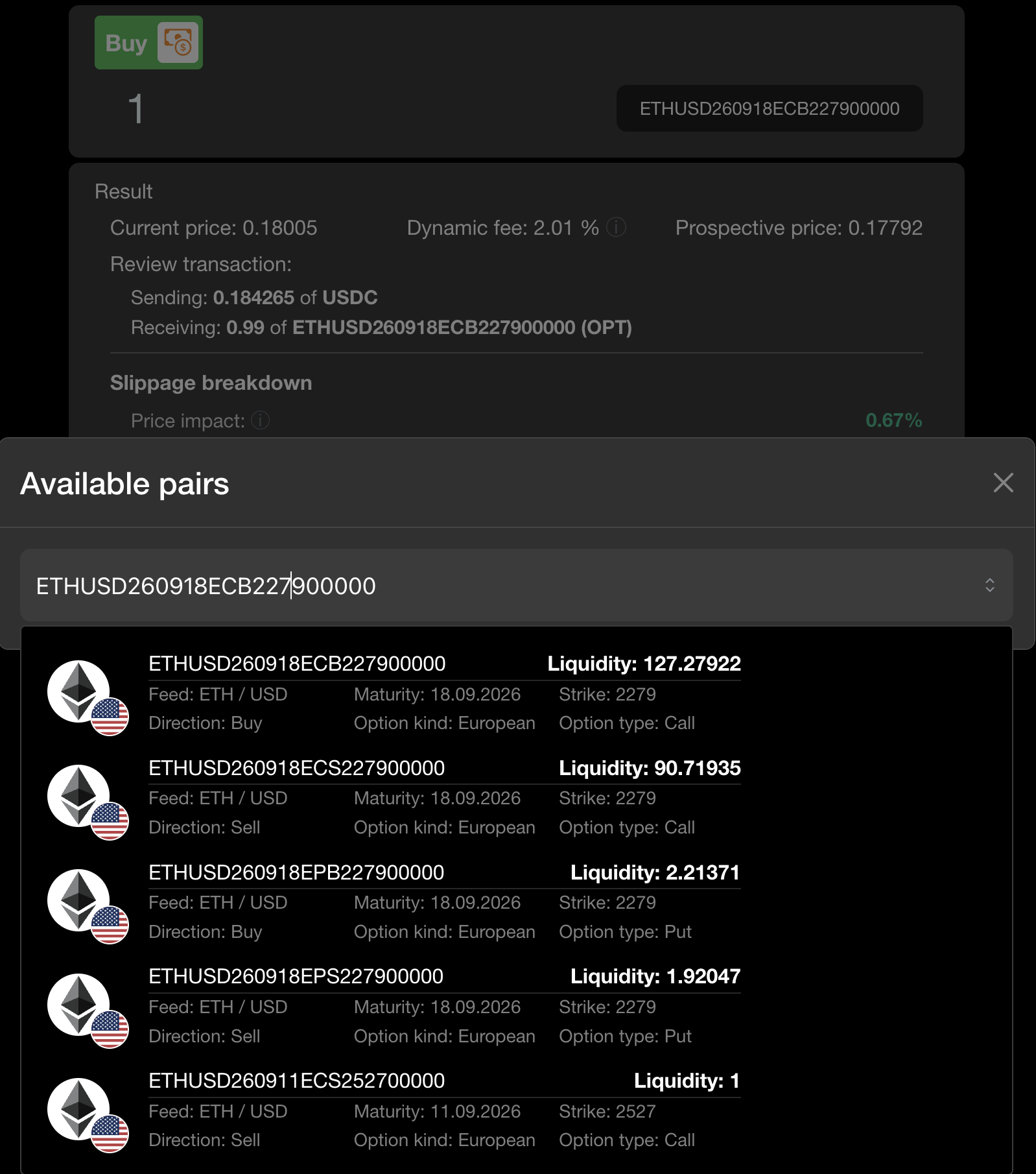
Why the quote asks for more USDC than you typed
The AMM's fee is taken in USDC, on top of your input, and it is dynamic — it grows as the pool price drifts from the model price. A pool trading close to fair value charges the 2% floor. See Dynamic swap fee.
5. Wait for expiry, then exercise
European options settle only at expiry. After your option's Friday starts:
- Go to
/options_balanceand find the position. - Exercise it. The contract pays out your leg's share of the collateral in USDC, less the protocol's 0.5% fee on that payout.
Nobody else needs to act for this to work — you are settling against the contract, not against a counterparty. And you don't have to be quick: an expired option keeps its value until you claim it.
You can leave before expiry
Holding to expiry is optional. Any leg can be sold back on /swaps at any time up to its maturity, which is usually how a profitable position gets closed.
What to read next
- Core concepts — the five ideas that make this protocol different from a vanilla options venue. Worth 5 minutes before you size up.
- Payoff & pricing — exactly what you'll be paid at expiry.
- Fees — who takes what, and when.